Frequently Asked Questions
If the answer to your question is not listed below,
please feel free to give us a call directly on
+44 (0)1235 462500
or email us at
sales@bowman.co.uk.
What is a PTFE lined plain bearing?
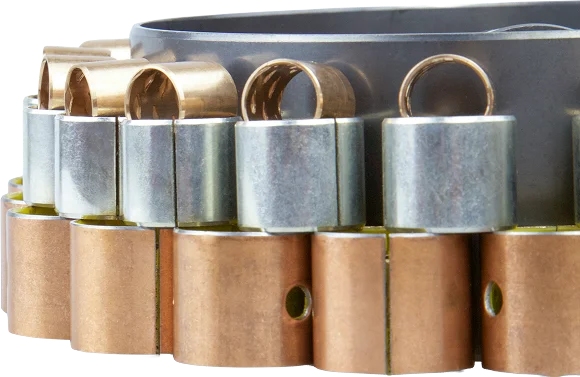
A PTFE lined plain bearing is a self-lubricating bearing designed to provide low-friction, maintenance-free operation. Bowman WMU® plain bearings feature a carbon steel backing, a porous sintered bronze interlayer, and a PTFE-based sliding surface, delivering excellent wear resistance, high load capacity, and long service life across a wide range of industrial applications.
Can WMU® plain bearings run without lubrication?
Yes. WMU® PTFE lined plain bearings are specifically designed for dry-running operation. The PTFE sliding layer provides excellent low-friction performance without the need for continuous lubrication, making these maintenance free plain bearings ideal for applications where regular greasing is impractical or contamination must be avoided.
What is the PV rating of WMU® PTFE lined bearings?
WMU® bearings are designed to offer excellent PV (pressure-velocity) capability, allowing them to perform under demanding combinations of load and sliding speed. The maximum permissible PV value depends on factors such as operating temperature, shaft material, lubrication conditions, and duty cycle. Bowman can provide detailed technical data and application-specific recommendations to ensure optimum bearing performance.
What sizes of WMU® plain bearings are in stock?
Bowman stocks a comprehensive range of metric PTFE plain bearings and imperial PTFE bushings UK to suit a wide variety of industrial applications. In addition to standard sizes, Bowman offers an in-house machining service to manufacture non-standard bearings to meet specific customer requirements.
How do WMU® bearings compare to bronze bushings?
Compared with traditional bronze bushings, WMU® PTFE lined plain bearings provide significantly lower friction, require little or no lubrication, and offer improved wear resistance in many applications. Their self-lubricating composite construction helps reduce maintenance requirements, minimise downtime, and deliver more consistent performance, particularly in dry-running or difficult-to-access operating environments.